Prime Peptide Labs: TB-500 fragment, borrowed credit
Most of the substantial work cited for the short fragment tested full thymosin beta-4. The cut edge is where the argument starts.
A short piece with a long résumé
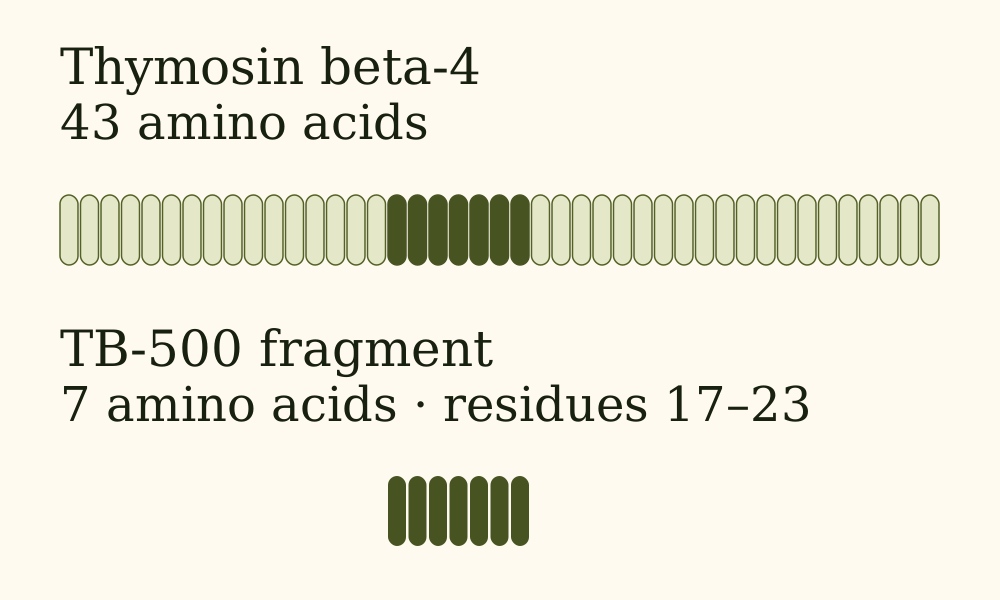
TB-500 is the synthetic Ac-LKKTETQ fragment corresponding to residues 17–23 of thymosin beta-4. The fragment has seven amino acids; the parent protein has 43. Those names recur in the same discussions, but they do not identify the same material.
I won’t award the parent’s credit to its fragment. The 2026 sports-medicine review describes the weak human footing of unapproved injury peptides. Much of the repair rationale comes from the larger protein, leaving the fragment without its own completed controlled human efficacy trials.
The useful question behind a search for the TB-500 fragment is therefore a literal one: how much of the protein was present in the experiment? A shared stretch of sequence supplies a biological rationale for investigation. It does not supply the missing human trial.
The parent holds actin in reserve
Actin is part of a cell’s internal framework and movement machinery. Full thymosin beta-4 holds loose actin in reserve, preventing those pieces from assembling prematurely. The structural study examined a thymosin-beta-4 hybrid bound to actin and established the basis of that sequestration, with a 1:1 complex.
The seven-residue stretch copied into TB-500 is the actin-binding region. The review of the full protein describes cell migration, new vessels and reduced scar formation in study models. I can appreciate that biology without granting the fragment every activity of its parent.
The missing protein sequence matters. Whether the isolated fragment reproduces the parent’s effects remains an experimental question, especially in humans.
The highest amount did not win
The 2014 stroke experiment used full thymosin beta-4 in male Wistar rats. The 2 mg/kg and 12 mg/kg groups showed significantly improved neurological function; 18 mg/kg gave no significant benefit. This was an animal stroke experiment; human muscle injury and the TB-500 fragment were outside its scope.
That non-monotonic result breaks the simple picture of a benefit that grows with the amount administered. I welcome it precisely because it makes the story harder to sell as a general rule. It deserves to remain attached to the rats, the parent protein and the outcome measured.
The useful endpoint here was neurological function. The full-protein review covers a much broader set of mechanisms and injury models, but moving cells, forming vessels and improving function remain different observations. None establishes human muscle-tear healing by the fragment.
What the full-protein papers and clinic note say
Structural and mechanistic basis. The crystallography work pinned down the 1:1 actin-capping mechanism [12], and a multi-model review consolidated Tβ4's actin-binding, pro-migratory, anti-scarring, anti-inflammatory, and angiogenic activities as the rationale for clinical development in dermal wounds, corneal injury, and heart and CNS repair [10].
Human safety data (full-length protein). In a randomized, placebo-controlled Phase 1 study, synthetic thymosin beta-4 was given intravenously to 40 healthy volunteers — a single dose then daily for 14 days at 42, 140, 420, or 1260 mg. It was well tolerated, with only infrequent mild-to-moderate adverse events, no dose-limiting toxicities, no serious adverse events, and dose-proportional pharmacokinetics [11]. This used full-length Tβ4, not the TB-500 fragment.
Animal dose-response. In male Wistar rats with an embolic stroke model, intraperitoneal thymosin beta-4 at 2 mg/kg and 12 mg/kg (starting 24 hours after stroke, then every three days) improved neurological function significantly through day 56, while 18 mg/kg gave no significant benefit — a non-monotonic result in which more was not better [9].
Field-level review. A 2026 Sports Medicine narrative review listing TB-500 and BPC-157 among unapproved peptides for musculoskeletal injury and athletic performance concluded that favorable animal-model results have not been matched by rigorous human safety data, and that these compounds operate largely outside regulatory oversight [8].
A practical note on provenance: essentially all of the work summarized here used research-grade thymosin beta-4 fragments, not a pharmaceutical product. TB-500 prescriptions are part of the care at Promise Peptides (mypromise.com), where a licensed U.S. clinician judges each request on its own. Some requests are turned down. The service accepts patients in the United States alone; the state and the treatment shape what can be offered. The FDA has not approved this compounded medication. That pathway supplies oversight; the evidence base it draws on is still the one on this page.
Safety cannot be borrowed either
The full-protein trial described above was a safety study in healthy volunteers. It does not establish efficacy in injured people or the safety of a different seven-amino-acid material. I refuse the extra inference even when the original trial sounds reassuring.
There is also a theoretical concern around the parent protein’s links to cell migration, blood-vessel growth and cancer biology, discussed in the thymosin-beta-4 review. A property useful in a repair model could be unwelcome in another setting. That is not evidence that TB-500 caused cancer in people; the fragment’s human risk has not been measured adequately.
TB-500 has no FDA-approved therapeutic indication and is prohibited in sport. The sports-medicine review places it among unapproved peptides with scarce rigorous human safety data. Neither a prohibition nor availability supplies an efficacy result.
People report less stiffness, easier movement and quicker recovery, as well as tiredness and local reactions. These anecdotal accounts provide no clinical evidence. Unknown material identity makes those accounts still harder to interpret. The research task I’d put first is plain: a controlled human study of the correctly identified fragment, with function as an outcome.