GHK-Cu acquired a copper partner
The original plasma peptide, the copper complex and a combination hair treatment all appear in this story. They deserve separate credit.
A liver observation on the way to skin
The beginning is stranger than a skincare slogan. Loren Pickart isolated GHK from human plasma in 1973 as a factor that prompted aged human liver tissue to synthesize proteins more like younger tissue. The skin-regeneration review recounts that plasma discovery; it does not describe a person becoming younger.
GHK is a tripeptide, a chain of three amino acids. Add bound copper and the name becomes GHK-Cu, also known in cosmetics as Copper Tripeptide-1. The GHK sequence occurs in type I collagen, the structural protein that gives skin and tendon strength. The tissue-remodelling review traces those connections through cell, animal and human work.
I like the untidy route from a liver observation to skin research. It supplies a better question than “is this anti-aging?”: which version of the peptide did a particular experiment test, and what changed there? Free GHK and the copper complex do not become the same substance merely because a headline drops the suffix.
More collagen, without more cells
The 1988 fibroblast-culture experiment has a pleasingly narrow result. Fibroblasts, the cells that make much of the surrounding structural tissue, produced more collagen after exposure to GHK-Cu. The rise did not depend on a change in cell number. The experiment tested human cells in culture rather than people receiving treatment.
That distinction is why this result earns a place near the front of the cabinet. I value the distinction between cells doing more of a particular job and a vague suggestion that everything grew faster. It is a specific biological observation, with a specific setting.
The 2015 review also describes increased collagen production in 70% of treated women, compared with 50% for vitamin C and 40% for retinoic acid. Those figures concern the collagen outcome reported in topical skin work. They do not say that 70% of wrinkles vanished, establish superiority across every skin outcome, or validate an injectable treatment.
GHK-Cu penetration through the skin barrier
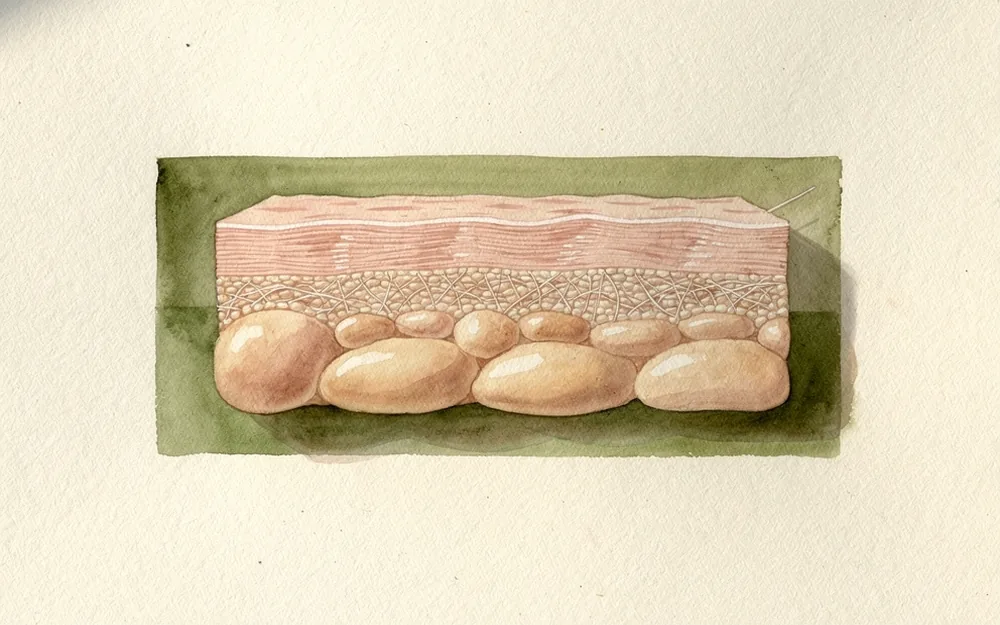
The collagen cultures appeal to me, until the outer skin layer enters the picture. The 2025 topical-GHK review puts poor penetration at the centre of the problem. A peptide can be active beside a cell in a dish and still struggle to reach that cell from the surface of intact skin.
The 2011 penetration experiment measured copper moving through human skin samples and accumulating in deeper tissue over 48 hours. That work was ex vivo: skin studied outside a living person. It measured copper applied as the peptide complex; it cannot settle every question about how an intact complex behaves in a person.
Delivery research also studies modified forms and ways of disturbing the barrier. I won’t let a modification pass for the original GHK-Cu with a different wrapper. A fat-linked peptide or a pretreated skin sample changes the experiment. This makes formulation part of the evidence, rather than a minor afterthought.
The hair trial has another ingredient
The 2016 hair-growth trial enrolled 45 men with androgenetic alopecia, or male-pattern hair loss, and followed them for 6 months. The preparation combined 5-aminolevulinic acid with GHK. The trial tested the GHK combination rather than GHK-Cu alone.
Reported hair-count increases were 52.6 for the 100 mg/mL preparation and 71.5 for the 50 mg/mL preparation, versus 9.6 for placebo. Those concentrations describe the study preparations. They are not instructions for use. No adverse events were reported in any group.
The lower-concentration preparation had the larger reported increase. I’m reluctant to smooth that awkward result into a neat more-is-better story. More fundamentally, the combination gets the credit for a combination result. The paper cannot isolate what GHK contributed, and its participants were not testing the copper complex advertised in many broader claims.
A large gene claim on a small label
The 2018 gene-data review is the source of a much-repeated scale claim. Its threshold table concerns about 2,100 genes changing by at least half; the roughly 4,000 figure is a broader extrapolation. Among the affected genes, 59% were more active and 41% less active. These gene-expression and database findings leave longer life and whole-body rejuvenation unproven.
I give that work less weight than its impressive vocabulary might suggest. Much of the foundational literature comes from Pickart and colleagues, and the broader gene claims still need confirmation beyond that concentrated body of work. A large list of altered genes is a starting point for further experiments.
There is no FDA-approved drug indication for GHK-Cu. Copper Tripeptide-1 has a history as a topical cosmetic ingredient; that is different from drug approval or evidence for systemic use. The topical review discusses the formulation limitations, including instability around strong reducing agents and low-pH ingredients. The published record also leaves long-term systemic copper handling unresolved.
Reports of smoother skin sit beside accounts of redness, itching and uneven pigmentation. Those anecdotal community reports provide no clinical evidence or established side-effect rates. For the next study, I’d choose a less glamorous question than rejuvenation: can a well-characterised topical preparation produce a reproducible, useful effect beyond the small studies already described?